Blog 004: Linking the Essentials of Baccalaureate Education to the NCLEX-RN® Examination and the NCLEX® Program Reports

The NCLEX® Program Reports provide important insight into the performance of baccalaureate graduates on the NCLEX® Examination. That’s one reason why the NCLEX® Program Reports are used by many nurse educators when leading curriculum planning and program evaluation.
Chapter 4 and part of Chapter 6 of the NCLEX® Program Reports provide information about the performance of a program’s graduates in each of the NCLEX® Test Plan areas. The NCLEX® Detailed Test Plan provides a summary of the content and scope of the NCLEX® Examination in each of the eight NCLEX® Test Plan areas and serves as a guide for candidate preparation. Within each Test Plan area, the Detailed Test Plan contains a list of related content (topics), a list of activity statements, and some sample items.
AACN’s Essentials of Baccalaureate Education for Professional Nursing Practice provides a widely accepted framework of curricular elements for baccalaureate nursing education. The Essentials emphasize such concepts as patient-centered care, interprofessional teams, evidence-based practice, quality improvement, patient safety, informatics, clinical reasoning/critical thinking, genetics and genomics, cultural sensitivity, professionalism, and practice across the lifespan in an ever-changing and complex healthcare environment. Essential IX, “Baccalaureate Generalist Nursing Practice”, is the culmination of Essentials I-VIII and covers the knowledge, skills, and attitudes necessary to practice at the completion of a baccalaureate nursing education program (AACN Essentials, 2008).
Given the importance of the NCLEX® Examination and AACN Baccalaureate Essentials, the NCLEX Panel of Experts wondered what the relationship was between the competencies addressed by AACN and the knowledge, skills and abilities covered by the NCLEX® Examination.
A Micro Study
Four nursing education experts from Mountain Measurement’s NCLEX Panel of Experts independently evaluated the applicability of each of the 119 activity statements of the 2016 NCLEX® Detailed Test Plan to Essential IX. Baccalaureate Generalist Nursing Practice of (AACN Essentials, 2008). The experts rated each activity statement along a 4-point Likert scale from “Does Not Apply” to “Very Much Applies” For example, the panelists rated the alignment of NCLEX activity statements such as, “Apply knowledge of Nursing procedure, pathophysiology and psychomotor skills when caring for a client with an alteration in body systems,” to AACN Essential IX. as "Very Much Applies".
The results were not surprising. Almost all of the 119 activity statements were rated as “Very Much Applies” to Essential IX. Only a few activity statements were not fully aligned as indicated by the panelists’ ratings. An example of the areas of Essential IX that did not apply or there was not consensus among the experts were “Arrange cultural immersion care giving experiences in settings such as homeless shelters, migrant clinics, correctional facilities and corporate health.” The coordinated appraisal of AACN Baccalaureate Essential IX (i.e., relevance rationale, outcomes delineation, and sample content) with the NCLEX-RN® Detailed Test Plan was followed by an evaluation of the aggregated responses and consensus building discussions.
Discussion
Although the implications of the study’s findings may be obvious, they are fundamentally important. The NCLEX® Examination and thusly the NCLEX® Program Reports address the activities which AACN has defined to be the Essentials of Baccalaureate General Nursing Practice. The strong alignment between the 119 activity statements of the NCLEX® Detailed Test Plan (NCSBN, 2016) and AACN Essential IX. Baccalaureate Generalist Nursing Practice (AACN, 2008) suggests that educators which structure classroom and clinical learning activities to include the 119 activity statements are directly addressing the knowledge, skills, and abilities needed for their students to attain the expected competencies identified by AACN in Essential IX.
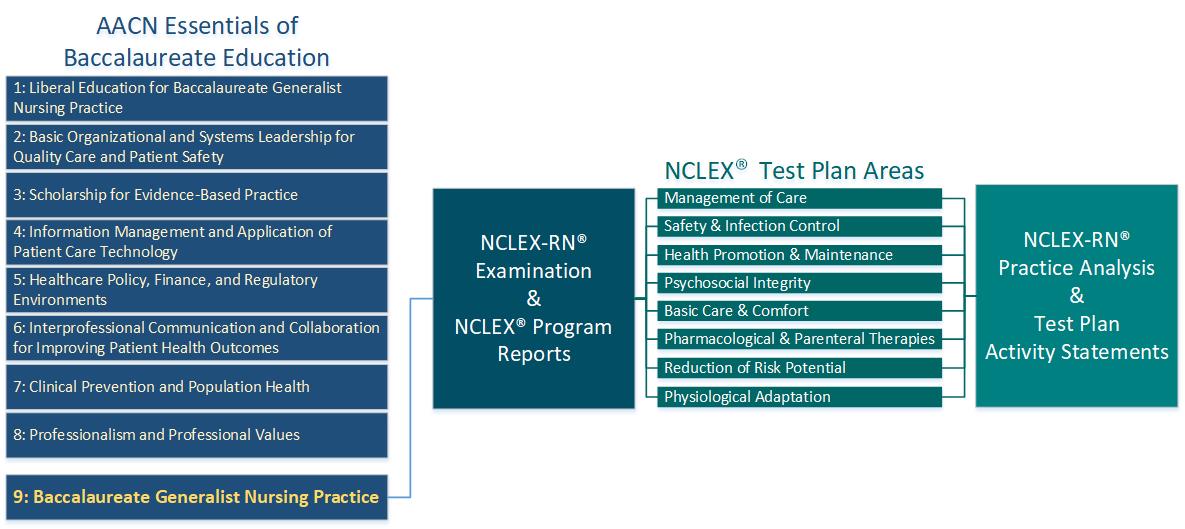
Of course, the NCLEX® Examination does not cover everything that is described within the AACN Essentials of Baccalaureate Education. The first Essential, “Liberal Education for Baccalaureate Generalist in Nursing Practice” goes well beyond the scope of the NCLEX® Examination. Another example would be Essential III, “Scholarship for Evidence–Based Practice.” The NCLEX® Examination in its current form does not really test evolving evidence for changing nursing practice. Because the NCLEX® Examination does not completely cover all of AACN’s Essentials, the NCLEX® Program Reports should not be the sole source of program evaluation data.
All nursing educators are faced with a faculty shortage, a wide diversity of students, the demands of many different learning styles, a decrease in the number and quality of clinical sites and hands-on experiences and the relentless demands for NCLEX results to reflect positively on the performance of faculty and students. Program accreditation standards and Board of Nursing regulations require all nursing educators to be involved in measuring nursing program outcomes. This study reinforces the relevance of the NCLEX® Examination and the NCLEX® Program Reports for evaluating baccalaureate graduates. Taken together, all nursing educators should be involved in reviewing the NCLEX® Program Reports and incorporating their findings into their improvement plan.
Since many educators are new to the NCLEX® Program Reports, it is important that they have good direction on their use. I recommend that nurse educators attend one of the NCLEX® Program Reports Professional Development Seminars. This will optimize the efficiency, accuracy, and completeness of their analysis of the information provided in the Program Reports which will ultimately enhance their ability to evaluate and monitor the development and assessment of learners’ knowledge, skills, and abilities to provide high quality, safe nursing care.
Preparing graduates to deliver safe, effective nursing care consistent within national standards and reflective of the expected competencies of baccalaureate graduates spelled out by AACN challenges nursing programs. To meet this challenge, programs should use the information found in the NCLEX® Program Reports pertaining to the categories of Client Needs to evaluate outcomes and include classroom and clinical learning activities targeted to the 119 activity statements of the NCLEX® Detailed Test Plan and the eight categories of Client Needs which organize them.
References
Continue reading this article
Sign up for a free account to access the full blog post and more.
Create Free Account Already have an account? Log in