Blog 003: Incorporating the NCLEX® Program Reports into a Systematic Evaluation Plan for Nursing Programs

My nursing education colleagues often discuss program evaluation and best practices to successfully achieve our program outcomes; most often, we talk about the NCLEX® pass rate. All of the Boards of Nursing have regulatory requirements and the nursing education accreditation agencies have accreditation standards which address collecting and using data in a deliberate manner to evaluate a nursing education program.
- Accreditation Commission for Education in Nursing (ACEN)
- Commission on Collegiate Nursing Education (CCNE)
- Commission for Nursing Education Accreditation (CNEA)
Results Orientated Program Evaluation
Although the worth of any nursing education program cannot be singularly measured by its NCLEX® pass rate, it is the number we all have in common. Nonetheless, the pass rate is not enough to inform the faculty as to what areas of the curriculum may need revision.
What do I mean? These Reports are not simply placed in a binder on the shelf. Rather, I guide the faculty through an assessment of the data provided in the reports, summarize our findings, and reference these heavily during curriculum revision. The NCLEX® Test Plan is driven by the Practice Analyses conducted by the National Council of State Boards of Nursing (NCSBN). NCSBN conducts a practice analysis every 3 years by surveying newly licensed nurses (less than one year) about their practice, utilizing activity statements developed by volunteer subject matter experts (NCSBN, 2017).The NCLEX® Program Reports can help faculty with this task. A good portion of the NCLEX® Program Reports is dedicated to providing faculty members with information about the performance of their graduates along the Categories of Client Needs described in the NCLEX® Test Plan. Our program utilizes the NCLEX® Program Reports to evaluate graduate’s performance on the NCLEX®; specifically, utilizing the Client Needs Categories/Subcategories and the content dimensions.
These activity statements are written to reflect current practice in a wide variety of practice settings across all of the jurisdictions. An example of an activity statement is, “Advocate for Client Rights and Needs”, which can be found in both the 2017 RN Practice Analysis and the 2018 LPN/LVN Practice Analyses. These activity statements are organized into the NCLEX® Test Plan using the Categories of Client Needs as a framework.
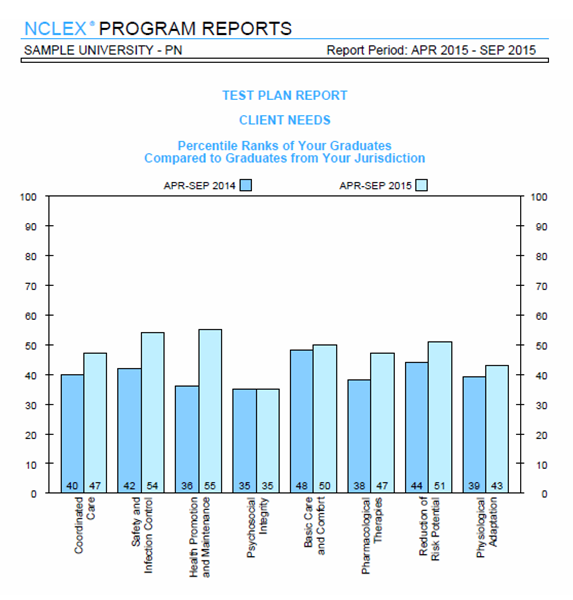
The Bar Chart to the left is an example of the information available in the NCLEX® Program Reports offering valuable data regarding nursing graduate’s test performance in comparison to other programs in your jurisdiction and beyond.
How to Get Started
As a first step, I encourage my nursing education colleagues to read the detailed NCLEX® Test Plan. Why? The NCLEX® Test Plan is updated every 3 years and describes the knowledge, skills, and abilities that a newly licensed nurse is expected to possess. In 2014, NCSBN reviewed the characteristics of entry-level nurses that participated in the practice analyses over a 9-year period and discovered that the healthcare environment had become more complex (Review of Entry-Level Characteristics and the NCLEX). Is your curriculum keeping up? Are your clinical placements or simulations providing the opportunity for contemporary practice?
Next Steps
Utilize your NCLEX® Program Reports in a thoughtful and deliberate manner. Within your program’s evaluation plan, identify a responsible point person and the frequency at which your program will review the Reports.
Remember to document in your meeting minutes and evaluation plan when each review was conducted, the results of the review, and any action that was taken in response to the findings. This process promotes the continuous quality improvement described in the accreditation standards.
Professional Development Courses
Not sure how to best use your NCLEX® Program Reports? Professional Development Courses are available to help nursing educators analyze and interpret the information contained in the Reports and are conducted by experts in assessment and data analysis and nurse educators with expertise in the content of the NCLEX® Examination and program evaluation.

NCLEX® Program Reports Professional Development Course attendees participating in Human Histogram Exercise
The mission of these courses is to help nurse educators maximize the utility of the information contained in the NCLEX® Program Reports. This is accomplished through a variety of learning methodologies to analyze and interpret your program’s Reports, identify trends in your program’s performance, utilize the NCLEX® Test Plan and Content Dimensions to understand curricular challenges and opportunities identified by the Reports, and successful program evaluation using the Reports.
Redefining Success in Nursing Programs
By incorporating your program’s NCLEX® Program Reports into your program’s systematic evaluation plan, your faculty will have a tool that provides data on the preparation of your program’s graduates to practice at their level of licensure. The NCLEX® Program Reports can also provide your faculty with insight into the preparation of their program’s graduates for competent nursing practice.
These data can be used to direct learning experiences to develop nursing knowledge, skills, and abilities for safe and effective entry-level nursing practice. Remember, nursing education prepares graduates for practice in the profession, not simply for passing the NCLEX®.
References
National Council of State Boards of Nursing. (2014). A Review of Entry-Level Nurse Characteristics and the NCLEX®. Chicago: Author.
National Council of State Boards of Nursing. (2018). 2018 LPN/VN Practice Analysis: Linking the NCLEX-PN® Examination to Practice. Chicago: Author.
National Council of State Boards of Nursing. (2018). 2017 RN Practice Analysis: Linking the NCLEX-PN® Examination to Practice. Chicago: Author.
Worthen, B.R. & Sanders, J.R. (1974). Educational Evaluation: Theory and Practice. Belmont, CA: Wadsworth Publishing.
Continue reading this article
Sign up for a free account to access the full blog post and more.
Create Free Account Already have an account? Log in